


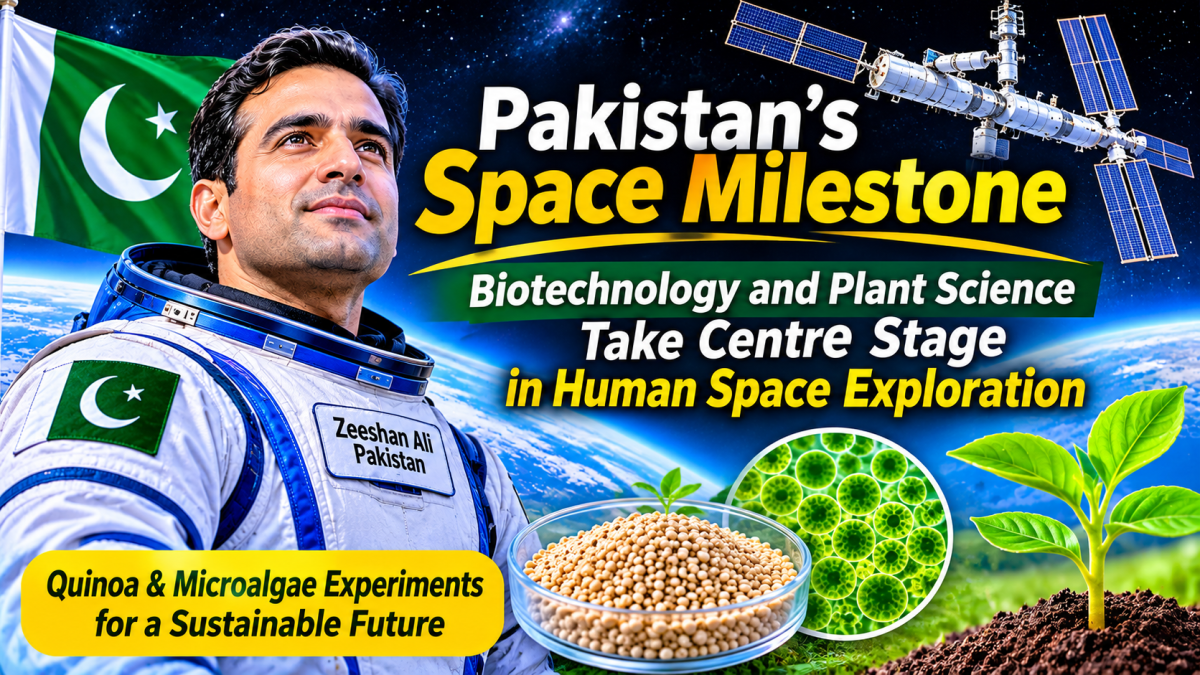
Pakistan’s participation in China’s space programme opens new opportunities for biotechnology, plant genomics and sustainable agriculture beyond Earth.
Pakistan’s growing involvement in space exploration has brought an exciting new dimension to the country’s scientific ambitions, particularly in biotechnology and agricultural research. The country’s participation in China’s human spaceflight programme has highlighted the potential of Pakistani scientific expertise to contribute to research addressing some of humanity’s most challenging questions: how to grow food, sustain life and protect biological systems beyond Earth.
Among the most interesting research areas associated with the mission are experiments involving quinoa and microalgae. These organisms have considerable scientific importance because of their potential applications in future space agriculture and life-support systems.
Why Quinoa Matters in Space Research
Quinoa is widely recognised as a nutrient-rich crop with considerable potential for sustainable agriculture. Its ability to grow under different environmental conditions makes it an interesting candidate for space-based agricultural research.
Studying quinoa seeds under space conditions could help scientists understand how microgravity and cosmic radiation influence seed viability, plant development, genetic stability and nutritional quality.
Such research could eventually contribute to developing crops suitable for future long-duration space missions, where astronauts may need to produce some of their own food.
Microalgae: Tiny Organisms with Enormous Potential
Another important research area is the use of microalgae and cyanobacteria in space-based life-support systems.
These photosynthetic microorganisms can absorb carbon dioxide and release oxygen under suitable conditions. Certain species can also serve as potential sources of protein, lipids, vitamins and other valuable biomolecules.
Understanding how microgravity affects their growth, photosynthesis and metabolism could support the development of biological systems for future space stations and missions to the Moon and Mars.
Opportunities for Pakistani Biotechnology
This research has important implications for Pakistan’s scientific community. Universities and research institutions could explore new interdisciplinary research programmes connecting plant biotechnology, molecular biology, genomics, synthetic biology and space science.
Potential research directions include:
- Identifying genes associated with plant adaptation to microgravity.
- Investigating the effects of space radiation on DNA stability and gene expression.
- Studying photosynthetic efficiency under altered gravity conditions.
- Developing microalgae-based biological life-support systems.
- Exploring stress-responsive genes in crops with potential applications in space agriculture.
From Earth Agriculture to Space Agriculture
For a country facing challenges related to climate change, food security, water scarcity and agricultural sustainability, research in space biotechnology could also generate valuable knowledge for terrestrial agriculture.
Understanding how plants respond to extreme environmental conditions may help scientists investigate stress tolerance, improve crop resilience and develop innovative agricultural technologies.
Pakistan’s participation in international space research should therefore be viewed not only as a milestone in space exploration but also as an opportunity to strengthen its biotechnology, agricultural genomics and scientific innovation sectors.
The future of space exploration will not depend only on rockets and spacecraft. It will also depend on biology, biotechnology and the ability to sustain life beyond Earth.
How do you evaluate this reporting?
Dr. Muhammad Shafiq
Staff correspondent and investigative writer for Telex Newsroom.